


Less Is More Blog Productivity Tips

Order your electronic copy of the survey report ($19.95 for a limited time)

Social Media Survey Report

The survey about the use of e-mail and Social Media has been completed and the survey report is now available. Learn more and order your copy!

Download Free eBook

The Results Curve(tm): How to Manage Focused and Collaborative Time.

Download now 

Join our Free Webinars

Less-is-more Blog by Pierre Khawand

Current Articles | RSS Feed RSS Feed

When everything is a priority, nothing is a priority! Overcome priority overload!


managing prioritiesI couldn't have said it any better. "When everything is a priority, nothing is a priority" said my client today as I was shadowing him in order to better understand his organization's work process and tailor our training programs accordingly. Shadowing is such an insightful exercise. It allows us to take a look at what is under the hood; the nuances that make each work environment unique. It is a great learning for everyone involved; the observer, the one being observed, and everyone around them.

Back to the priority overload

Priority overload seems to be a common complaint which we hear about often in our workshops. It is a complaint that we need to pay closer attention to!

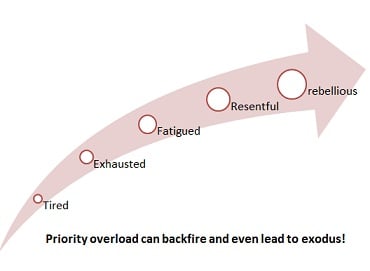
Creating a priority (such as communicating that an issue is urgent or a task needs to be performed under a tight deadline) needs to be taken very seriously and exercised with utmost care. If not, and if too many priorities are created, and if they are reactive rather than strategic, the result is counterproductive if not even harmful. If this persists over time, it can lead to the team getting tired, then exhausted, then fatigued, resentful, and maybe rebellious. Then comes exodus!
managing priorities

By the way, priority overload need not be confused with changing priorities and with being flexible and responsive to changes in the marketplace. Priority overload is about having too many priorities to the detriment of being successful at any of them. Changing priorities on the other hand is part of being dynamic and responsive, but should also be considered carefully and strategically.

The key question: "What is the link?"

So how do we ensure that the priorities we are creating or changing are carefully selected and don't backfire? One practice that we stress in the Accomplishing More With Less Workshop is a simple but overlooked one, which is getting into the habit of asking the question "What is the link?" In other words, what is the link between this task, or this priority or project, and the end results that we are seeking? If the link is clear, we are good to go. If not, trouble is on its way and careful reassement is in order!

Managers and executives, beware!  And be strategic! And be attentive as to whether your team is already on the graph above!

Comments

That statement totally describes my work environment. I am the go to person at work. It is easy to get overwhelmed by the amount of work that is assigned all needing to be done yesterday. I always state it is hard to prioritize when everything is a priority, so it might get to a point where nothing will get done in an urgent manner. I enjoyed this article.
Posted @ Thursday, May 12, 2011 11:13 AM by Katie Johnson
Yes, this article is correct, it is so easy to become overwhelmed. To help myself cope, I share a quick summary of my task list with manager and team whenever their expectations exceed my ability to accomplish those expectations.
Posted @ Thursday, May 12, 2011 11:31 AM by Ann Bjelland
Pierre, you hit it with the link to the end in mind being the key. I am a strong proponent of strategic thinking and try my hardest at it. One key component of it, I believe, is mindfulness - the awareness that what we do and the choices we make have an impact and we need to see how it affects the big picture or the end goal.  
I feel that oftentimes a crisis is created because tasks that are important but not urgent get shoved to the bottom of the pile. Uncompleted, that task over time becomes urgent and gets added on to the ever-growing pile of urgent priorities. In this case, discipline to do what is important yet not urgent, will prevent priority overload. 
One other aspect that also warrants examination is the amount of workload assigned to the team. Might the problem be too much work and not enough people? It is well and good to have team members that are strategic and disciplined, but if the work is too much, no amount of prioritization will make the team effective at reaching its goals.
Posted @ Thursday, May 12, 2011 11:57 AM by Rose Penelope Yee
Dear Pierre, 
 
Our server went down last night and we lost everything. Our It failed to set up our email correctly so I cannot recover the information for todays seminar. 


Please advise. 


So truly "what is the link" for today's seminar. 


Lilly
Posted @ Thursday, May 12, 2011 12:54 PM by Lilly
Priorities … excellent insights, Pierre. If you've ever had the misfortune of working around a command-and-control boss who manages by intimidation, it gets even worse. Your blog gives reason to pause and ask, "What is my communication/management style? Am I articulating our priorities, wisely and skillfully?"
Posted @ Thursday, May 12, 2011 2:33 PM by Steve Loosley
Thank you Katie, Ann, Rose, Lilly, and Steve! Great to hear your experiences, and thanks for being part of our community. 
 
By the way, Rose, you won the prize of the week! Every week now we are doing a drawing and one of the people who comment on the blog will get a prize. It is a book. This week's book is Life After College by Jenny Blake. Please e-mail us at training@people-onthego.com your mailing address, and include "blog comment weekly prize winner" in the subject line!
Posted @ Thursday, May 12, 2011 3:10 PM by Pierre Khawand
What an unexpected treat! Thank you so much!
Posted @ Thursday, May 12, 2011 3:59 PM by Rose Penelope Yee
In this economy, some organizations have whittled staff down to the point that everybody still employed is overwhelmed and as you suggest, the stress is showing. I keep an active priority list and when a new priority is handed down, I respond with what will be delayed in order to meet the new deadline. Occasionally, I get told that the 'new priority' is not as high as previously thought and get advice to finish the truly higher priorities first. I work hard and don't mind putting in the extra time to learn new tasks but there are limits no matter my attitude. I'm fortunate to have a smart boss who understands what I'm doing and works with me to get the first things done first. 
 
Posted @ Thursday, May 12, 2011 6:40 PM by Al
Al, that is great approach! This is exactly the kind of "setting expectation" and "negotiation" that needs to be done to manage the priority overload. It is quite rewarding when managers are in tune with this approach and when they appreciate it and work with it. Congratulations to your manager! And to you for initiating this process!
Posted @ Thursday, May 12, 2011 6:46 PM by Pierre Khawand
Post Comment
Name
 *
Email
 *
Website (optional)
Comment
 *

Allowed tags: <a> link, <b> bold, <i> italics

Subscribe by Email

Your email:

Write your comments!

We want to hear from you. Please write your comments in the blog and let us know what you think. We are eagerly awaiting your insights, tips, and suggestions!